Page 1 of 1
Another frame packaging method
Posted: Mon 07 Jan, 2008 7:32 pm
by The Crofter
Not sure if anyone is using corrugated roll for packing frames but this method solves a lot of problems in a stroke.
Cut piece 2.5 x height of frame.
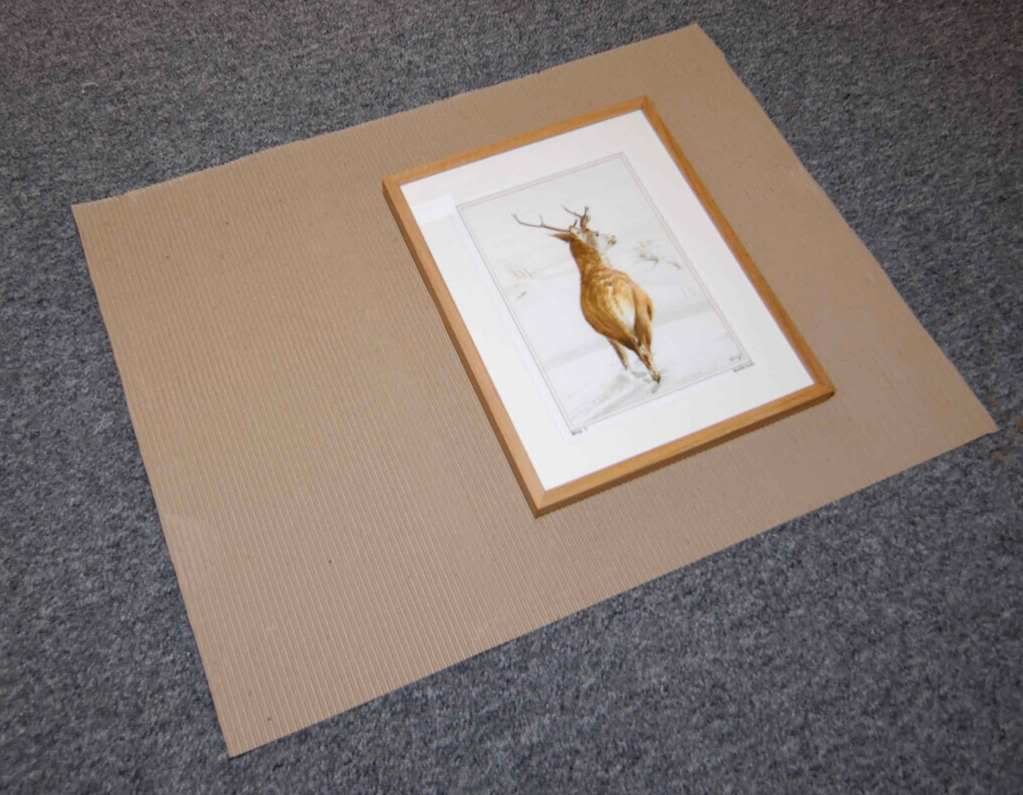
Staple side flaps.
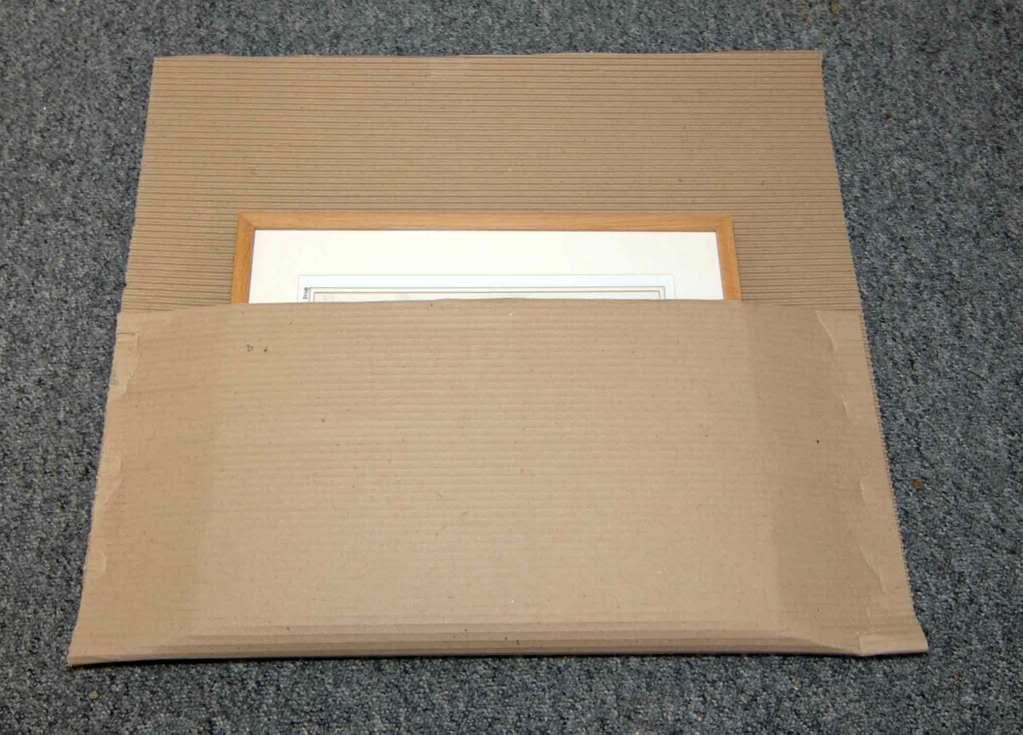
Attach tape to hold flap in place.
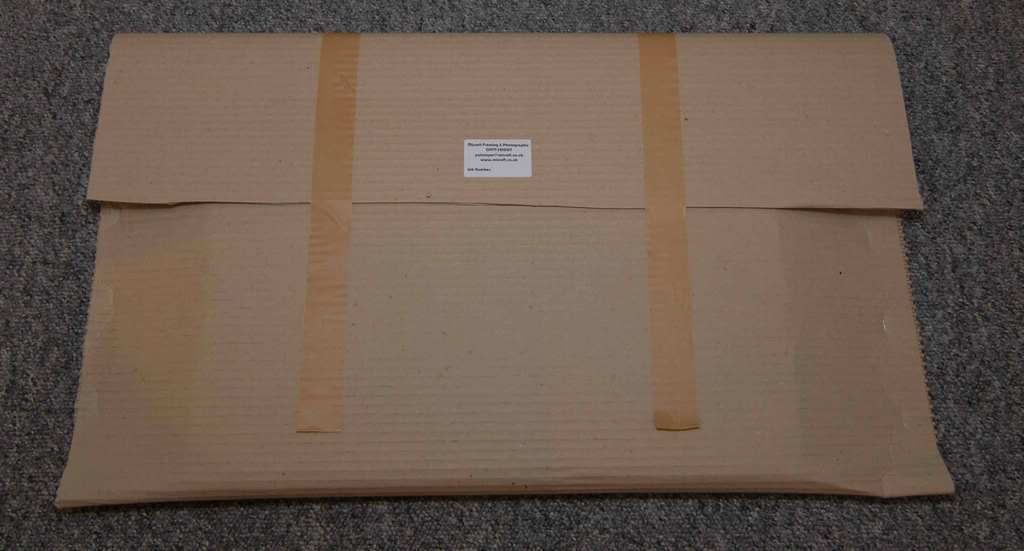
Pocket can easily be opened to show customer the work. Flap can also be stapled to complete the pocket. This method offers good protection for the corners and will allow frames to be stacked or placed on edges for transportation. Naturally the corrugated card is recyclable.
A suitable label will also advertise the business.
Posted: Mon 07 Jan, 2008 9:03 pm
by Moglet
Ooooooooh! Now that I r-e-a-l-l-y like, Pat!

Now that I've got a bench dedicated to pack 'n' wrap during open hours/handfinished stuff outside gallery hours (note how I'm resigning myself to my unwished-for fate, Prospero et al!


) I'm in a better position to look at different packaging options. I've even given my Magik Wand system a permanent home
on top of the bench at last!!
Using your wrapping method could be a
real timesaver for me. How big is a new roll of corrugated, Pat?
Posted: Mon 07 Jan, 2008 10:42 pm
by Not your average framer
Moglet wrote:Ooooooooh! Now that I r-e-a-l-l-y like, Pat!
Yes, me too! Where I was trained, they had a packing bench with a very nice idea incorporated into it. Under the front edge of the bench were two D-rings with a length of picture wire between them. A split ring (key ring) was able to slide along this wire and another length of picture wire was attached between this split ring and another.
When the required amount of corrogated paper had been pulled of the roll from underneath the bench and across this front edge of the bench, then the corrogated was cut by placing ones index finger into the ring and pull it from one side of the bench to the other which pulled the shorter length of picture through the corrogated and producing the required cutting action. It worked brilliantly, every time.
Posted: Mon 07 Jan, 2008 11:48 pm
by The Crofter
I will measure the roll tomorrow. However I purchased this from Lion at least 6 years ago (long story) and I see it is no longer listed in their catalogue. I guess bubble wrap is more popular but would be interested to hear if the corrugated roll is available from another supplier.
Posted: Tue 08 Jan, 2008 12:14 am
by Moglet
I think I remember Kev mentioning somewhere on the Forum that he uses corrugated cardboard...

Kev - if you do use the above, can you recommend a supplier? Ta in advance!

One thing I especially like about your method, Pat, is that you can pack the frame as soon as it's finished, keeping it well-protected prior to collection, and yet it is still really easy to pop it out for the customer to have a look-see before taking it home! Personally, I love seeing the reaction on people's faces when they're really pleased with work one has done, and this packing method really does give one the best of both worlds!

Posted: Tue 08 Jan, 2008 1:42 am
by osgood
Corrugated cardboard would certainly protect a finished frame from bumps etc, but I would be concerned with it scuffing the surface of some finishes.
Cardboard has some abrasive properties that may be detrimental unless separated from the frame by another product, perhaps plastic.
Cardboard is probably best as a form of outer packaging. I'm not too sure I would be using it up against any of my frames!
As far as wrapping a package, then unwrapping it again to show the customer is concerned, I just don't have the time or inclination to be doing anything twice, especially wrapping! Life is way too short and I could be allocating that extra time to another job which I might have more chance of getting paid for!
Posted: Tue 08 Jan, 2008 2:50 am
by Moglet
Hi Ormond!
osgood wrote:Cardboard has some abrasive properties that may be detrimental unless separated from the frame by another product, perhaps plastic.
The way that I now hope to go for average to medium-sized frames is to first shrinkwrap the frame and
then put it into the corrugated cardboard "envelope." That should solve the problem of scuff marks (e.g. on lacquer finishes). Also, the shrinkwrap should help with keeping the cardboard fibres off the finished frame. This method should also eliminate the likelihood of the customer pulling bumpers off the back of the frame when they remove the bottom corner protectors.
As far as wrapping a package, then unwrapping it again to show the customer is concerned, I just don't have the time or inclination to be doing anything twice, especially wrapping! Life is way too short and I could be allocating that extra time to another job which I might have more chance of getting paid for!
For me, Ormond, immediately putting the finished frame into a protective package is
highly advantageous, since many of my customers are very slow to pick up completed work. It is all too easy to accidentally damage a finished frame while it is sitting around the workshop, and one can end up performing retouches, etc. There have been a couple of occasions where I have had something dent or badly scratch the moulding, and I've had to completely replace the frame rim (costing both time
and materials!!).
For the few seconds it would take to pop the frame out of a corrugated cardboard envelope, complete final inspection and allow the customer to view the work, then pop it back in and seal it up for transport would suit me from the perspectives of logistics and business style. Therefore, I think it's time well invested: Both the customer and myself jointly see that the work is completed satisfactorily, and I get to gauge the customer reaction to my work; the latter being important to me from the perspectives of customer satisfaction, personal satisfaction, and to help me to develop confidence in myself as a designer. Also, because the customer pick-up would be speedier (i.e. they are not hanging around waiting for me to wrap it in kraft paper), it will be another way of enhancing the customer's experience of doing business with me.
Posted: Tue 08 Jan, 2008 7:57 am
by osgood
For me, Ormond, immediately putting the finished frame into a protective package is highly advantageous, since many of my customers are very slow to pick up completed work. It is all too easy to accidentally damage a finished frame while it is sitting around the workshop, and one can end up performing retouches, etc.
Áine,
I'm sure you are on the right track with using shrink wrap inside the cardboard. that should give you an extremely well protected frame.
My completed frames are packaged in clear bi-fold plastic and heat sealed on the other three sides. This is where I have drawn my 'packaging line'. I want to use a form of protection that is easy and quick to do and that works. I've used this system for many years and have not had any damage to a frame while still in my storage area.
Time is a big issue for me and this method is satisfactory for me, but other people may want to use other more time consuming methods and I applaud anyone who makes a big effort in this area. Everyone has to work out what type of packaging that gives them satisfaction and there are many answers to this issue, just as there are many answers to most aspects of framing.
Packaging each frame takes me less than two minutes. If I went the trouble of adding cardboard, then unwrapping the cardboard to show the customer, it might add another 3 to 5 minutes per frame, which could mean 50 to 70 hours per year. That's way too much for me, but not for some!
You are very wise to set a high standard of business and this will benefit you greatly!
Posted: Tue 08 Jan, 2008 4:22 pm
by kev@frames
Moglet wrote:I think I remember Kev mentioning somewhere on the Forum that he uses corrugated cardboard...
Kev - if you do use the above, can you recommend a supplier? Ta in advance!
One thing I especially like about your method, Pat, is that you can pack the frame as soon as it's finished, keeping it well-protected prior to collection, and yet it is still really easy to pop it out for the customer to have a look-see before taking it home! Personally, I love seeing the reaction on people's faces when they're really pleased with work one has done, and this packing method really does give one the best of both worlds!
My supplier is a local distributors, carters polythene in Cornwall, so probably not much help. However I saw our local D&J simons Rep, Stuart, who took some away to show the management, so they may be supplying the stuff in due course.
Comes on dang big rolls! You could try ebay.ie for packaging suppliers maybe?
Posted: Tue 08 Jan, 2008 4:48 pm
by Merlin
Having seen Kev's workshop. Those rolls of corrugated cardboard are really big.
In fact so are the rolls of bubble wrap.
We just have not got the room to store umpteen quantities of the stuff, that is why we went with rolls of cellophane and corner protectors.
The work is wrapped as soon as it is completed and stored in the 'completed bin'. The customer can see the finished work as soon as it is pulled, without having to basically unpack it from the corrugated stuff.
Just my thoughts !!
Posted: Tue 08 Jan, 2008 4:52 pm
by kev@frames
Merlin wrote:Having seen Kev's workshop. Those rolls of corrugated cardboard are really big.
In fact so are the rolls of bubble wrap.
We just have not got the room to store umpteen quantities of the stuff, that is why we went with rolls of cellophane and corner protectors.
The work is wrapped as soon as it is completed and stored in the 'completed bin'. The customer can see the finished work as soon as it is pulled, without having to basically unpack it from the corrugated stuff.
Just my thoughts !!
yeah, for the shop we simply cellophane wrap them too.
Generally we'll offer some protection once they've seen it (it boils down to the weather... corrugated if its not raining, bubblewrap if its raining) to the customer if the frame is any decent size so they have a fighting chance of getting it home.
What is a useful thing is the "cling wrap" on a 4 inch roll (with a handle).
Posted: Tue 08 Jan, 2008 4:56 pm
by Merlin
kev@frames wrote:
What is a useful thing is the "cling wrap" on a 4 inch roll (with a handle).
I will second that. So many uses..